Japanese artist, Yayoi Kusama has recently staged an interactive art piece 'Obliteration Room' in the Gallery of Modern Art, Brisbane; as part of her 'Look Now, See Forever' exhibition. The furnished room began as a blank canvas that was transformed, over a two week period, into an explosion of dizzying colour.Kusama effectively curated a growing environment which challenged the conventions of the 'white cube' by encouraging interaction. I find the concept of interactivity in this context quite compelling. Yayoi is well known for her immersive installations, as I find out at her recent exhibition in Tate modern. However, we were forbidden to touch or photograph anything..much to my disappointment.
Wednesday, 6 June 2012


Tadao Cern in a Lithuanian photographer and artist who has recently created a series of 'portraits' titled 'Blow Job'. The title refers to the gale force winds that the models were subjected to. The result was a striking and often humorous distortion of the face. Although it is a fairly simple idea, each portrait is intriguingly different. I like this idea of invisible distortion and manipulation of the skin.


Categorise and Compare

Ernst Haeckel
'Art Forms in Nature'
Tafel 67. Vampyrus Chiroptera

Sand grains viewed at 250 x magnification.
Dr Gary Greenburg has spent five years collecting a variety of sand grain specimens from around the world. Particles of crystal fragments and spiral fragments of shells and volcanic crumbs are revealed.
Dr Gary Greenburg has spent five years collecting a variety of sand grain specimens from around the world. Particles of crystal fragments and spiral fragments of shells and volcanic crumbs are revealed.

Alphonse Bertillon
'Forty eight ears of french criminals', circa 1900
Tuesday, 5 June 2012
Talking of Wunderkammers
I find the act of categorisation quite intriguing, and the Wunderkammer is a fascinating example. The English translation is 'Wonder- room' but it is also known as the 'Cabinet of curiosities...or Wonders'. Their creation in the C16th stemmed from the European desire to understand the world by categorising the vast variety of objects that surrounded them. There were two broad categories, manmade and natural, that were further split into subjects such as geology and ethnography.
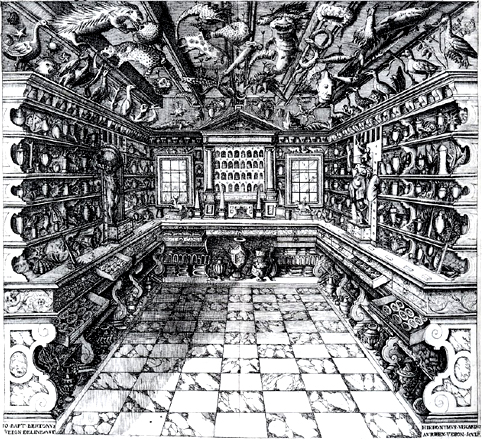
The museum of Francesco Calceolari in Verona, from Ceruti and Chiocco 1662

The Evolution Store in Soho, New York. It offers a contemporary, retail interpretation of a Wunderkammer.

Joseph Cornell 'Untitled' (The Hotel Eden) 1945
Cornell is well known for his 'Wunderkammer' style box assemblages. They house a series of juxtaposed objects that previously existed as precious objects. His technique was associated with the Surrealists.
A collection of 'things'
In a recent tutorial, my group were asked to display a collection of objects and images that we had kept for known or unknown reasons. The display was an attempt to explain our interests and to create links between them. As I like to to surround myself with a hybrid of 'things' my collection was split into a few categories, creating my own mini Wunderkammer. The largest category that emerged highlighted my interest in several 'tions'...distortion, fragmentation, transformation, reflection, transition, representation, appropriation. It also emphasised my interest in the movement of the body and the relation it has to the space around it.


A few of the pieces from my collection

From left to right: Handmade 'emu' acetate earrings, photo taken of the River Derwent- peak District, Eadward Muybridge holographic postcard, hologram pendant, coloured glass, burnt silver inkjet paper, John Stezaker 'Pair IV' collage 2007.

Disintegrating leaf and wire jump rings made from tin strips

Illustration by Marcos Chin 'Textile' and red rubber bands
Subscribe to:
Posts (Atom)